Here is the end of the documentation page for a feature at an invented company:
Invoices: known limitations
Each invoice uses your workspace's currency.
Refunds are for the full invoice amount.
Invoices can be exported one at a time.
Recurring invoices aren't supported. Create each invoice manually.
Tax is calculated with the standard rates for your region.
Credit notes aren't supported.
Every line on that list was cut on purpose, so the first version could ship in six weeks instead of six months. The page says what is missing. It doesn't say why, or when anyone should look at it again. Three of the reasons were written down with a condition for revisiting them. The other three ended up somewhere else:
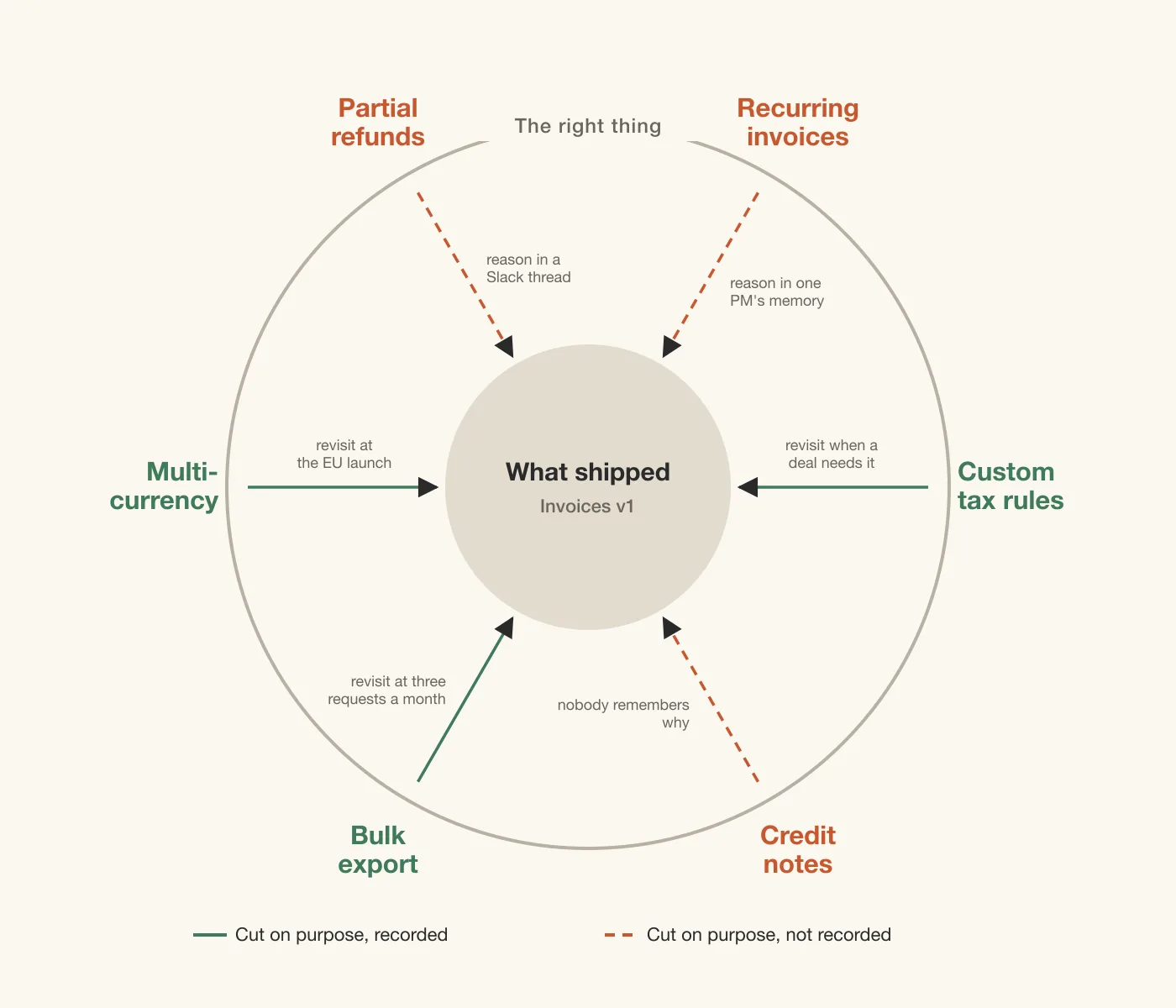
The head of a Lisp company made the case for shipping the smaller thing, and named it, more than thirty years ago.
The right thing and the New Jersey approach
Richard P. Gabriel had a Lisp company, Lucid, Inc., from 1984 until 1994. "The Rise of Worse is Better" is an excerpt from "Lisp: Good News, Bad News, How to Win Big," a keynote Gabriel was invited to give at EuroPAL, a small Lisp conference, and gave in March 1990 at Cambridge University. According to Gabriel's own history of the essay, published with it on dreamsongs.com, Jamie Zawinski later found the paper, excerpted the worse-is-better sections and sent them to friends at CMU, and AI Expert magazine republished the piece in June 1991. The quotations here are from the excerpt and that history page.
The essay compares two design styles. The first, which Gabriel calls the MIT approach, is captured by the phrase "the right thing." Its designer wants simplicity, correctness, consistency and completeness, and "it is more important for the interface to be simple than the implementation." For completeness: "All reasonably expected cases must be covered."
The worse-is-better philosophy, which Gabriel calls the New Jersey approach after early Unix and C, is "only slightly different." Simplicity of implementation comes first: "It is more important for the implementation to be simple than the interface. Simplicity is the most important consideration in a design." Correctness gives a little: "It is slightly better to be simple than correct." And completeness gives the most: "Completeness can be sacrificed in favor of any other quality. In fact, completeness must be sacrificed whenever implementation simplicity is jeopardized." Rather than introduce "either implementational complexity or inconsistency," it is "better to drop those parts of the design that deal with less common circumstances."
Gabriel caricatured the New Jersey approach on purpose, to make it look bad: "I have intentionally caricatured the worse-is-better philosophy to convince you that it is obviously a bad philosophy and that the New Jersey approach is a bad approach." And then: "However, I believe that worse-is-better, even in its strawman form, has better survival characteristics than the-right-thing."
Where the hard case went
The essay's best-known story is about one hard case. Two famous people, one from MIT and one from Berkeley working on Unix, meet to discuss operating systems. The MIT person asks how Unix handles the "PC loser-ing problem," which arises when an interrupt arrives while a user program is in the middle of a lengthy system routine. The right thing is for the system to back out and restore the program so it can re-enter the routine. Unix doesn't. Instead, "the solution was for the system routine to always finish, but sometimes an error code would be returned that signaled that the system routine had failed to complete its action. A correct user program, then, had to check the error code to determine whether to simply try the system routine again."
The New Jersey side defended it: "programmers could easily insert this extra test and loop." The MIT side's objection was that "the implementation was simple but the interface to the functionality was complex."
The hard case didn't go away. It moved out of the system and into every program that called it.
Half of the right thing
Gabriel's argument for why the New Jersey approach wins rests mostly on spread. Early Unix and C compilers "provide about 50%-80% of what you want from an operating system and programming language," and because they are simple to implement, they are easy to port. "Therefore, one expects that if the 50% functionality Unix and C support is satisfactory, they will start to appear everywhere." Software built this way, Gabriel writes, "first will gain acceptance, second will condition its users to expect less, and third will be improved to a point that is almost the right thing."
In the essay's big complex system scenario, the right thing "takes a long time to get out," because "the last 20% takes 80% of the effort."
The lesson, in Gabriel's words: "it is often undesirable to go for the right thing first. It is better to get half of the right thing available so that it spreads like a virus. Once people are hooked on it, take the time to improve it to 90% of the right thing."
There are two conditions on that lesson, and the essay states both. "It is important to remember that the initial virus has to be basically good." And, warning against taking the parable literally: "The 50% solution has to be basically right."
Agents ship the first half
The mapping that follows is ours, not Gabriel's. The essay is about programming languages and operating systems in the late 1980s, and its argument is about which software spreads, not how a team plans a feature. But the shape fits a product team using coding agents closely.
Coding agents make the first half cheap. A team can ship a v1 in weeks and leave the less common circumstances out, which is the New Jersey approach applied to a feature. That is often the right call, for the reason Gabriel gives: half of the right thing spreads, and "once people are hooked on it," there is time to improve it.
But look at what the strategy depends on. "Half of the right thing" means someone chose which half. "Basically right" means someone judged what the first version could not get wrong. "Improve it to 90%" means someone knows what the other half was, and when it becomes worth building. Every one of those is a product decision. The cut cases on the invoices page are not gaps in the code. Each one is an answer that says not yet, for a reason.
The PC loser-ing story has the same shape, in our reading. In Gabriel's telling, the hard case moved to every caller because of an explicit, argued tradeoff: implementation simplicity over interface simplicity. When a cut is never written down, the hard case moves to whoever calls just the same, without the argument on record. For the invoices feature, the callers are support, explaining full refunds to a customer who wanted half back; sales, promising multi-currency to a European prospect; and the next coding agent, asked to "fix" a ticket that says partial refunds don't work. The agent reads the code, finds no partial refunds, and has nothing that tells it the gap was deliberate. It may build the feature the team chose not to build, or a reviewer may approve it without knowing about the ledger change it needed.
Our essay on the modern product development lifecycle says that "Material decisions go to a named owner, routine ones stay with the team." Which half of a feature to ship is a material decision. The known limitations page records the outcome and leaves out the decision.
Where Brief fits: recording the half you cut
Brief is the product strategy agent. The homepage says it "captures decisions where they happen, connects them into one graph, and acts on them." In Gabriel's terms, it doesn't tell a team whether to build the right thing or the first half. It keeps the record of which half the team chose, why, and when to come back.
A cut is recorded as a decision, with its reason. In the Brief app, recording a decision requires both What was decided? and Why? before Record Decision will save it, and a decision can also carry Tags and a Re-evaluate when condition. "Invoices v1 refunds the full amount only, because partial refunds need ledger changes we can't make before launch," with a Re-evaluate when of "refund tickets asking for a partial amount pass ten a month," turns a line on the limitations page into a decision someone can find, question and revisit.
Cuts are read from where they were made. The reason for the partial refunds cut is in a Slack thread. The homepage says Brief "reads decisions from Slack, Jira, Confluence, and GitLab, self-hosted included." A scope cut agreed in a thread or a ticket comment doesn't have to stay there.
Agents check before they fill a gap. Coding agents set up with Brief search the recorded decisions before they start work, and ask Brief to check significant changes with brief_ask in check mode, which compares a planned change against existing decisions and flags conflicts. An agent asked to add partial refunds can meet the decision that left them out, and the reason, before it writes the change. Whether to build it then becomes a product question instead of a bug fix. People can run the same check with brief ask --mode check.
Unexplained cuts get an owner. Nobody remembers why credit notes were cut. In the app, Propose turns an open question into a pending decision and can name Who should decide?, which records who the question belongs to. With the user's approval, an agent can record a pending decision too, and agents can call brief_list_pending_decisions to see what is waiting. When a decision is pending, an agent can hold. The homepage shows an agent asked to add per-seat pricing to the checkout API learning that D-241, the seat-based pricing decision, is pending, and replying: "Holding the pricing change until D-241 is decided."
The second half starts from the first half's record. When the team comes back to improve the feature, each recorded cut still has its Why?, and when a decision changes, its History shows its status changes. The team can see what was cut and why, instead of rebuilding that list from memory.
None of this makes worse better, or better worse. Brief doesn't judge whether the first half was basically right, and it can only check against decisions it has. Where a cut was never captured, there is nothing for it to flag. What Brief changes is how many of the cut cases are known limitations with reasons, and how few are just missing.
Gabriel never settled the question. After arguing for worse is better, Gabriel argued against it under a pseudonym, wrote position papers on both sides in 2000, and summed up: "I still can't decide." Your team doesn't have to settle it either, feature by feature. But when you ship half of the right thing, does anyone know which half you left out, and why?
Objections
What is "worse is better"?
"Worse is better" is a software design philosophy described by Richard P. Gabriel in "The Rise of Worse is Better," an excerpt from the talk "Lisp: Good News, Bad News, How to Win Big." It puts simplicity of implementation first, and accepts some loss of interface simplicity, correctness, consistency and completeness to get it. Gabriel argued that software built this way "has better survival characteristics" than software built to do "the right thing."
What is the difference between the MIT approach and the New Jersey approach?
In Gabriel's essay, the MIT approach aims for "the right thing": a simple interface, correctness, consistency, and coverage of "all reasonably expected cases." The New Jersey approach, named after early Unix and C, puts a simple implementation first, so "completeness can be sacrificed in favor of any other quality," and it is better "to drop those parts of the design that deal with less common circumstances."
What did Gabriel say the lesson of worse is better was?
Gabriel wrote that "it is often undesirable to go for the right thing first. It is better to get half of the right thing available so that it spreads like a virus," and then "improve it to 90% of the right thing." The essay adds two conditions: "the initial virus has to be basically good," and "the 50% solution has to be basically right."
How does worse is better apply to AI coding agents?
Coding agents make a first version cheap to build, so teams can ship half of the right thing quickly. In our reading, the cases a team leaves out are product decisions, and when they aren't recorded, the next coding agent can't tell a deliberate gap from a missing feature. It may build what the team chose not to, or leave a reviewer to catch it.
How does Brief help teams that ship the first half?
Brief records product decisions, including scope cuts, with their reasons and an optional Re-evaluate when condition, and reads decisions from Slack, Jira, Confluence and GitLab. Coding agents set up with Brief search recorded decisions before they start work and use check mode to flag conflicts in significant changes, and unexplained cuts can be proposed as pending decisions that name who should decide. Brief can only check against decisions it has, so where a cut was never captured, there is nothing for it to flag.