Here is part of the instructions file for the coding agents at an invented company:
## Product rules

- Don't change pricing behaviour without approval.
- Keep the free plan generous.
- Deprecated API versions get no new features.
- Customer data for EU workspaces stays in the EU.
- Prefer the simplest fix.
Every line reads clearly. Every line also has more than one reasonable reading:
- Don't change pricing behaviour without approval. Are plan limits, like seat caps, part of pricing, or only the prices? Is approval the pull request review every change gets anyway, or a sign-off from whoever owns pricing?
- Keep the free plan generous. Generous compared to what? Is cutting free storage from 10 GB to 5 GB still generous if competitors offer 2 GB?
- Deprecated API versions get no new features. Is a bug fix that adds a missing field a feature?
- Customer data for EU workspaces stays in the EU. Do application logs count? Error reports sent to a monitoring vendor in the US?
- Prefer the simplest fix. Simplest to write, or simplest to undo?
Whoever wrote each rule knew which reading they meant. The file doesn't say. An agent reading it has no reason to ask, because every rule looks clear, so it picks a reading and builds. Here is the first rule on its own:
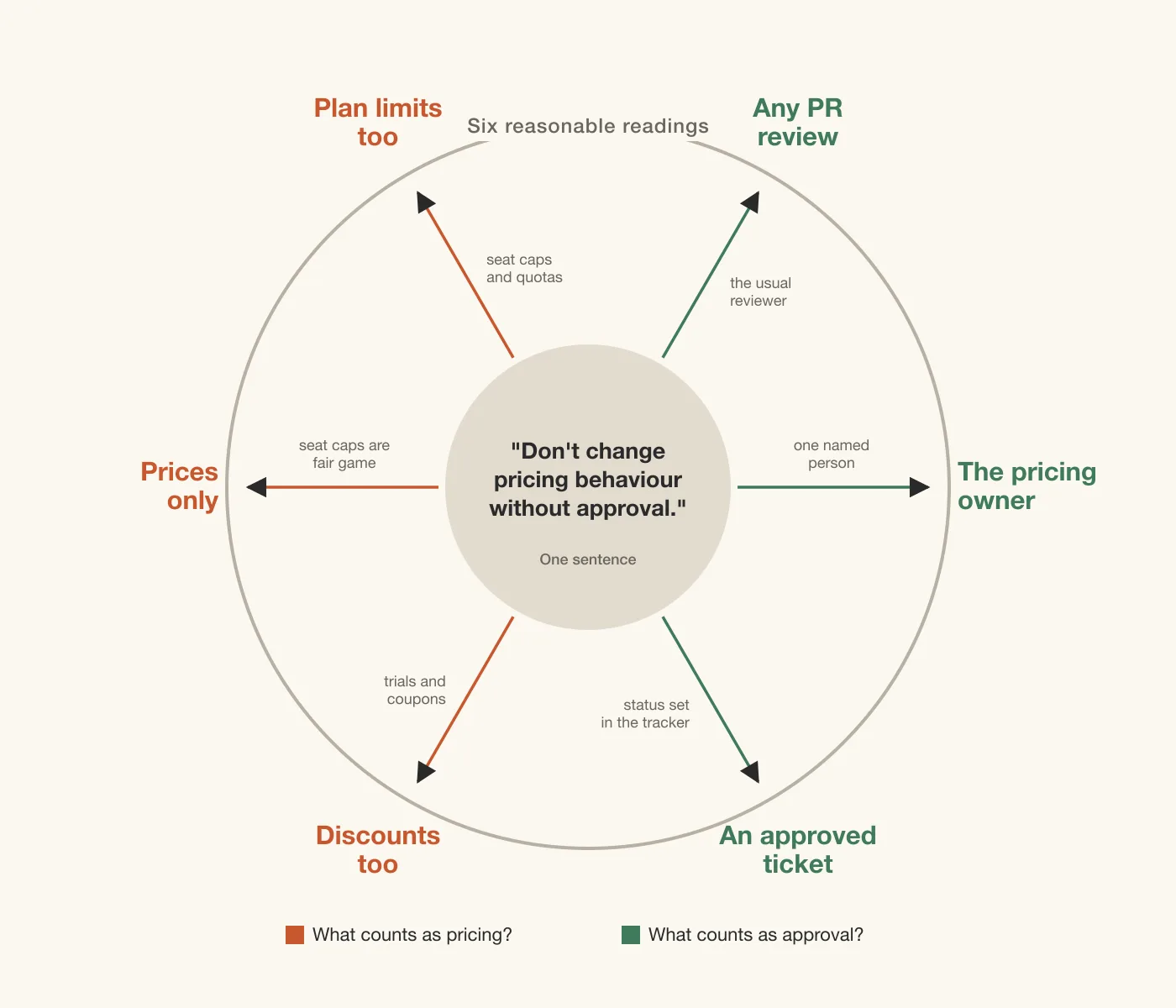
A computer scientist explained, decades before coding agents, why writing the rule in English didn't make it easier.
The faithful slave
Edsger W. Dijkstra wrote "On the foolishness of 'natural language programming'" as EWD 667, one of the numbered manuscripts collected in the E. W. Dijkstra Archive at the University of Texas at Austin. It is signed from Nuenen in the Netherlands, as a Burroughs Research Fellow. The manuscript isn't dated, but it mentions a technical report written in 1977, so it was written no earlier than that. The quotations here are from the archive's transcription.
It starts with a complaint Dijkstra had heard since "the early days of automatic computing": that programming "required the care and accuracy that is characteristic for the use of any formal symbolism." People "blamed the mechanical slave for its strict obedience with which it carried out its given instructions, even if a moment's thought would have revealed that those instructions contained an obvious mistake." They hoped for "more sensible machinery that would refuse to embark on such nonsensical activities."
High-level languages helped. "It was a significant improvement that now many a silly mistake did result in an error message instead of in an erroneous answer." Not everyone was grateful: "some people found error messages they couldn't ignore more annoying than wrong results," and some "still seem to equate 'the ease of programming' with the ease of making undetected mistakes." But the machine behind the language "remained, however, a faithful slave, i.e. the nonsensible automaton perfectly capable of carrying out nonsensical instructions."
Narrow interfaces
So it was proposed to build machines "that we could instruct in our native tongues." That would make the machines more complicated, but "by letting the machine carry a larger share of the burden, life would become easier for us." Dijkstra doubted it. "The choice of an interface is not just a division of (a fixed amount of) labour, because the work involved in co-operating and communicating across the interface has to be added." And "a change of interface can easily increase at both sides of the fence the amount of work to be done (even drastically so)." Hence "the increased preference for what are now called 'narrow interfaces'."
The essay's argument for formal symbols is short. "The virtue of formal texts is that their manipulations, in order to be legitimate, need to satisfy only a few simple rules; they are, when you come to think of it, an amazingly effective tool for ruling out all sorts of nonsense that, when we use our native tongues, are almost impossible to avoid." Dijkstra credits "the carefully, or at least consciously designed formal symbolisms that we owe to people like Vieta, Descartes, Leibniz, and (later) Boole," and concludes: "Instead of regarding the obligation to use formal symbols as a burden, we should regard the convenience of using them as a privilege."
Then the sentence that gives this post its subject. "When all is said and told, the 'naturalness' with which we use our native tongues boils down to the ease with which we can use them for making statements the nonsense of which is not obvious."
The essay ends with a guess. Dijkstra suspected that machines "to be programmed in our native tongues" are "as damned difficult to make as they would be to use."
Nonsense that isn't obvious
The mapping that follows is ours, not Dijkstra's. The essay is about programming languages, not product teams, and whether today's coding agents are the machines it had in mind is open to argument. But they do take their instructions in English, and much of the essay still applies.
The agent is not a faithful slave. It is closer to the "more sensible machinery" the complainers wanted: it will often catch an obvious mistake instead of carrying it out. But a rule with two readings isn't an obvious mistake. The agent picks one, and if it picks the reading nobody meant, there is no error message. There is a reasonable-looking pull request. In Dijkstra's terms, it is an erroneous answer instead of an error message, and the English made it easy to write a rule "the nonsense of which is not obvious."
The interface point holds too. Moving instructions into English didn't remove the work of being precise. It can add work on both sides of the fence. The person writing the rule now has to anticipate the readings a formal notation would have ruled out, and the reviewer has to work out which reading of "approval" the agent chose. We've written about why coding agents ignore your rules. Some of the time, the agent followed a reading of the rule that its author didn't mean.
Look at where the ambiguity sits in the five rules. None of it is about code. What counts as pricing, how generous is generous, whether a field is a feature, whether logs are customer data: each one is a product decision someone made, or hasn't made yet. Our essay on the modern product development lifecycle says that "Material decisions go to a named owner, routine ones stay with the team." A rule file has no place to say which decisions are material or who owns them.
Where Brief fits: a narrower interface for decisions
Brief is the product strategy agent. The homepage says it "captures decisions where they happen, connects them into one graph, and acts on them." It doesn't turn product decisions into a formal language, and Dijkstra wouldn't count it as one. A recorded decision is still written in English. What it changes is the shape of the interface: one decision at a time, with its reason, instead of a short list of rules meant to cover every case.
Each decision is written down with its reason. In the Brief app, recording a decision requires both What was decided? and Why? before Record Decision will save it, and a decision can also carry Tags and a Re-evaluate when condition. "Plan limits, including seat caps and storage quotas, count as pricing, because limits are how customers move between plans" picks one reading of the first rule and says why. The reason does work that the rule couldn't: an agent facing a case the decision didn't name has something to reason from.
Decisions are read from where they were made. The reading the rule's author meant usually lives in a thread or a ticket. The homepage says Brief "reads decisions from Slack, Jira, Confluence, and GitLab, self-hosted included." The meaning doesn't have to be copied into the instructions file by hand.
Agents check their reading before they build. Coding agents set up with Brief search the recorded decisions before they start work, and ask Brief to check significant changes with brief_ask in check mode, which compares a planned change against existing decisions and flags conflicts. An agent planning to raise a plan's seat cap can meet the decision that seat caps count as pricing before it writes the change. In our terms, that is the closest thing to an error message a product decision gets: a conflict flagged before the code, instead of a reasonable-looking pull request after it. People can run the same check with brief ask --mode check.
Open readings go to an owner. Some rules are ambiguous because nobody has decided yet. In the app, Propose turns an open question into a pending decision and can name Who should decide?, which records who the question belongs to. With the user's approval, an agent can record a pending decision too, and agents can call brief_list_pending_decisions to see what is waiting. When a decision is pending, an agent can hold. The homepage shows an agent asked to add per-seat pricing to the checkout API learning that D-241, the seat-based pricing decision, is pending, and replying: "Holding the pricing change until D-241 is decided."
The meaning keeps its history. A recorded decision keeps its Why?, and when a decision changes, its History shows its status changes. An agent or a reviewer can see which reading is current, not just which words are.
None of this makes English precise. A recorded decision can be ambiguous too, and Brief only knows the decisions a team records. When nothing has been recorded, check mode finds no conflict and the agent goes ahead with whatever reading it chose. What Brief changes is how many product decisions exist only as a line in a rule file, open to any reasonable reading.
Dijkstra imagined a native tongue being the only way in and out of computers right from the start, and guessed that "we would need all the intellect in the world to get the interface narrow enough to be usable." Which rule in your agents' instructions has a reading you never meant?
Objections
What is "On the foolishness of 'natural language programming'"?
It is a short essay by Edsger W. Dijkstra, numbered EWD 667 in the E. W. Dijkstra Archive at the University of Texas at Austin. Written no earlier than 1977, it argues that programming in a native tongue like English would not make programming easier, because formal symbols rule out nonsense that is "almost impossible to avoid" in natural language.
What did Dijkstra mean by narrow interfaces?
Dijkstra wrote that "the choice of an interface is not just a division of (a fixed amount of) labour," because the work of communicating across the interface has to be added, and that a change of interface "can easily increase at both sides of the fence the amount of work to be done." Dijkstra also imagined a native tongue being the only way in and out of computers right from the start, and guessed that "we would need all the intellect in the world to get the interface narrow enough to be usable."
Why did Dijkstra call natural language programming foolish?
Dijkstra argued that the "naturalness" of native tongues "boils down to the ease with which we can use them for making statements the nonsense of which is not obvious." The manipulations of formal texts, to be legitimate, need to satisfy "only a few simple rules," which makes formal texts an effective tool for ruling out nonsense. Instead of regarding the obligation to use formal symbols as a burden, Dijkstra wrote, "we should regard the convenience of using them as a privilege," because "thanks to them, school children can learn to do what in earlier days only genius could achieve."
How does Dijkstra's essay apply to AI coding agents?
Coding agents take instructions in English, through tickets and rule files like AGENTS.md. A rule can read clearly and still have several reasonable readings, and the agent picks one without an error message. In our reading, much of that ambiguity is about product decisions, such as what counts as pricing or who has to approve a change.
How does Brief help with ambiguous agent instructions?
Brief records product decisions one at a time with their reasons, including decisions it reads from Slack, Jira, Confluence and GitLab. Coding agents set up with Brief search recorded decisions before they start work and use check mode to flag conflicts in significant changes, and open questions can be proposed as pending decisions that name who should decide. Brief only knows the decisions a team records, and a recorded decision is still written in English.