Here is a postmortem at an invented company, with every field of the template filled in:
Incident: Starter workspaces could add unlimited seats
Severity: SEV-2
Duration: 11 days
Summary: A change to plan checks removed the five-seat cap on the Starter plan. Forty workspaces added seats they would have had to upgrade to the Team plan for.
Root cause: A coding agent removed the seat cap while working on the ticket "Simplify plan checks."
Action item 1: Block coding agents from editing the plan checks module.
Action item 2: Add a test that the Starter seat cap is five.
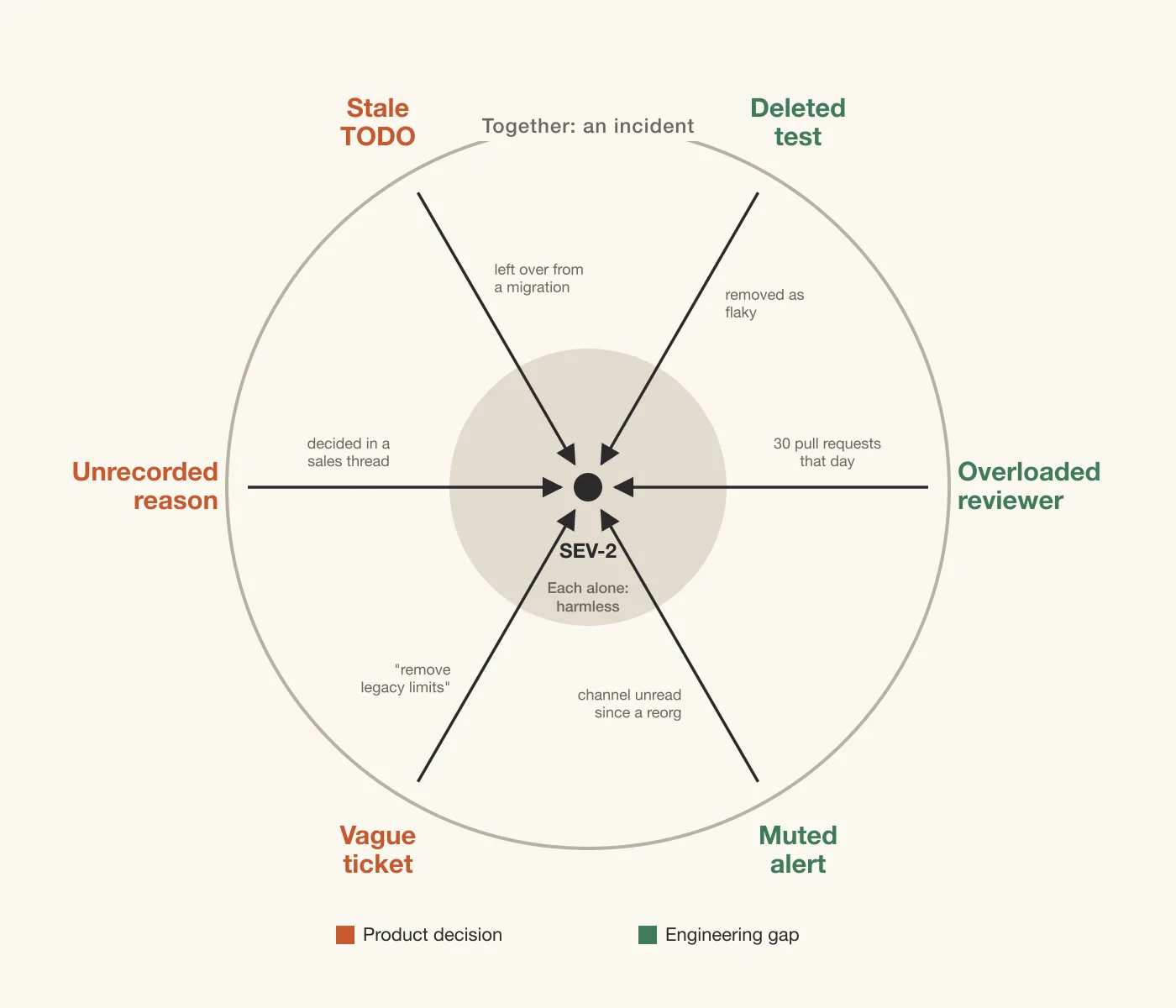
The template has one field for the cause. Here is what else had to be true for the incident to happen:
- The five-seat cap was decided in a sales thread two years ago, because the Team plan starts at six seats. Nobody wrote the reason anywhere an agent would read it.
- A comment next to the cap said "TODO: remove after migration," left over from an unrelated migration.
- The ticket said "remove legacy limits" and didn't say which.
- The test for the cap had been deleted months earlier for being flaky.
- The reviewer was covering for a teammate on leave and approved 30 pull requests that day.
- The alert for unusual seat growth went to a channel nobody had read since a reorg.
None of these would have caused the incident alone. Each had probably been true for weeks or months without anything going wrong.
A physician writing about patient safety described this pattern in a short treatise.
Eighteen points about failure
Richard I. Cook, MD, of the Cognitive Technologies Laboratory at the University of Chicago, wrote "How Complex Systems Fail," with the subtitle "Being a Short Treatise on the Nature of Failure; How Failure is Evaluated; How Failure is Attributed to Proximate Cause; and the Resulting New Understanding of Patient Safety." The text carries a copyright of 1998, 1999 and 2000. It is eighteen numbered points, each a heading and a short paragraph, and the quotations here are from the full text as published at how.complexsystems.fail. Cook's examples are "transportation, healthcare, power generation," not software.
The first points describe what such systems are like most of the time. They are "heavily and successfully defended against failure," with layers of technical, human and organizational defenses that "normally divert operations away from accidents." That is why accidents are rare and need several things to go wrong at once. In the third point, Cook writes that "single point failures are not enough": "Overt catastrophic failure occurs when small, apparently innocuous failures join to create opportunity for a systemic accident. Each of these small failures is necessary to cause catastrophe but only the combination is sufficient to permit failure."
Those small failures are always present. "Complex systems contain changing mixtures of failures latent within them," and "the complexity of these systems makes it impossible for them to run without multiple flaws being present." Because each flaw is "individually insufficient to cause failure," flaws "are regarded as minor factors during operations." Getting rid of all of them is limited "primarily by economic cost but also because it is difficult before the fact to see how such failures might contribute to an accident."
The root cause is a social need
The seventh point has the bluntest heading: "Post-accident attribution to a 'root cause' is fundamentally wrong." The reasoning follows from the third point. "Because overt failure requires multiple faults, there is no isolated 'cause' of an accident." The contributors are each "necessarily insufficient in itself to create an accident," and "it is the linking of these causes together that creates the circumstances required for the accident."
So why do organizations keep naming one? Cook's answer is that root cause evaluations "do not reflect a technical understanding of the nature of failure but rather the social, cultural need to blame specific, localized forces or events for outcomes."
Hindsight makes the single cause look obvious. "Knowledge of the outcome makes it seem that events leading to the outcome should have appeared more salient to practitioners at the time than was actually the case." Afterward, "it seems that practitioners 'should have known' that the factors would 'inevitably' lead to an accident." We've written about judging a decision by how it turned out. Cook's eighth point is the same trap seen from the postmortem.
Fixing the cause you named
The fifteenth point explains why the first action item won't help much. "Post-accident remedies for 'human error' are usually predicated on obstructing activities that can 'cause' accidents. These end-of-the-chain measures do little to reduce the likelihood of further accidents." The chance of an identical accident is "already extraordinarily low because the pattern of latent failures changes constantly." And such remedies can make things worse: they "usually increase the coupling and complexity of the system," which "increases the potential number of latent failures and also makes the detection and blocking of accident trajectories more difficult."
Blocking agents from one module is an end-of-the-chain measure. The same accident is unlikely to happen twice. The next one is more likely to come from a different undocumented decision lining up with a different vague ticket.
Two more points describe where the gaps get filled. In the eleventh, "Organizations are ambiguous, often intentionally, about the relationship between production targets, efficient use of resources, economy and costs of operations, and acceptable risks of low and high consequence accidents," and "all ambiguity is resolved by actions of practitioners at the sharp end of the system." In the fourteenth, "Change introduces new forms of failure." New technology adopted to reduce "low consequence but high frequency failures" may "actually create opportunities for new, low frequency but high consequence failures," and "these new forms of failure are difficult to see before the fact."
Agents at the sharp end
The mapping that follows is ours, not Cook's. The treatise is about patient safety and other hazardous systems, not software teams, and a seat cap is not a patient. But the postmortem fits Cook's description closely.
The coding agent is at the sharp end. "Remove legacy limits" was ambiguous, and the agent resolved the ambiguity the way Cook says the sharp end always does: by acting. It read the code, the TODO and the ticket, and none of them said the cap mattered. Coding agents are also the kind of change Cook's fourteenth point describes. They can remove a great many small, frequent failures, like typos, boilerplate and forgotten edge cases in code nobody cares about. They may also add a rarer kind: a reasonable change that collides with a decision only some people knew about.
Look at the six conditions again. Three are ordinary engineering gaps: a deleted test, a tired reviewer, a muted alert. The other three are about product decisions. The reason for the cap was never recorded anywhere an agent could read. A stale comment contradicted it. The ticket left the decision open. Those are latent failures too. They sit in a product for months, "regarded as minor factors during operations," until a change lines them up.
Our essay on the modern product development lifecycle says that "Material decisions go to a named owner, routine ones stay with the team." The seat cap was a material decision. It had no owner anyone could find, and no record an agent could read.
Where Brief fits: fewer latent decisions
Brief is the product strategy agent. The homepage says it "captures decisions where they happen, connects them into one graph, and acts on them." In Cook's terms, it can't remove the need for several defenses, and it can't stop failures from combining. What it can do is reduce one kind of latent failure, product decisions that exist only in people's memories, and add a defense earlier in the chain than review.
Decisions are written down with their reasons. In the Brief app, recording a decision requires both What was decided? and Why? before Record Decision will save it, and a decision can also carry Tags and a Re-evaluate when condition. "The Starter plan is capped at five seats, because the Team plan starts at six" turns the first condition on the list from a sales thread into a record.
Decisions are read from where they were made. The cap was settled in a sales thread. The homepage says Brief "reads decisions from Slack, Jira, Confluence, and GitLab, self-hosted included." A decision made in a thread doesn't have to wait for an incident to be written down.
Agents check before they build. Coding agents set up with Brief search the recorded decisions before they start work, and ask Brief to check significant changes with brief_ask in check mode, which compares a planned change against existing decisions and flags conflicts. An agent planning to remove the Starter seat cap can meet the decision before it writes the change, which puts a defense earlier in the chain than the tired reviewer. People can run the same check with brief ask --mode check.
Ambiguity goes to a person, not the sharp end. Cook says ambiguity is resolved by whoever acts. A ticket that says "remove legacy limits" is a question as well as a task. In the app, Propose turns an open question into a pending decision and can name Who should decide?, which records who the question belongs to. With the user's approval, an agent can record a pending decision too, and agents can call brief_list_pending_decisions to see what is waiting. When a decision is pending, an agent can hold. The homepage shows an agent asked to add per-seat pricing to the checkout API learning that D-241, the seat-based pricing decision, is pending, and replying: "Holding the pricing change until D-241 is decided."
The timeline exists before the postmortem. Hindsight distorts the view of what people knew at the time. A recorded decision keeps its Why? from when it was made, and when a decision changes, its History shows its status changes. A postmortem can see what had been decided before the incident, instead of reconstructing it afterward.
None of this makes the system safe, and Cook would say no single thing can: "Safety is an emergent property of systems; it does not reside in a person, device or department of an organization or system." Brief doesn't restore the deleted test, lighten the reviewer's load, or reroute the alert. It only knows the decisions a team records, and when nothing has been recorded, check mode finds no conflict and the agent goes ahead. What Brief changes is how many undocumented product decisions are sitting in the system, waiting for the right change to line them up.
Cook said there is no isolated cause of an accident, only contributors that happen to link. In your last agent-related incident, how many of the contributors were decisions nobody had written down?
Objections
What is "How Complex Systems Fail"?
"How Complex Systems Fail" is a short treatise by Richard I. Cook, MD, of the Cognitive Technologies Laboratory at the University of Chicago, with a copyright of 1998, 1999 and 2000. In eighteen numbered points it argues that complex systems always contain latent flaws, that accidents need several of them to combine, and that attributing an accident to a single root cause is "fundamentally wrong."
Why did Cook say root cause analysis is wrong?
Cook argued that "because overt failure requires multiple faults, there is no isolated 'cause' of an accident." Each contributor is insufficient alone, and only their combination produces the accident. Cook wrote that root cause evaluations reflect "the social, cultural need to blame specific, localized forces or events for outcomes" rather than a technical understanding of failure.
What are latent failures?
Latent failures are flaws that are always present in a complex system but are "individually insufficient to cause failure," so they are "regarded as minor factors during operations." Cook wrote that they change constantly and that it is "difficult before the fact to see how such failures might contribute to an accident."
How does "How Complex Systems Fail" apply to AI coding agents?
When a coding agent's change causes an incident, it is tempting to name the agent as the root cause and restrict it. Cook's argument suggests looking for the other contributors, which often include product decisions that were never recorded, stale comments and ambiguous tickets. Restricting the agent is an end-of-the-chain measure that leaves those latent failures in place.
How does Brief help reduce latent failures in product decisions?
Brief records product decisions with their reasons, including decisions it reads from Slack, Jira, Confluence and GitLab. Coding agents set up with Brief search recorded decisions before they start work and use check mode to flag conflicts in significant changes, and open questions can be proposed as pending decisions that name who should decide. Brief only knows the decisions a team records, and it doesn't fix other contributors like missing tests or overloaded reviewers.