Here is the search history of an engineer at an invented company, asked by a customer's account manager to raise the 10,000 row limit on CSV exports:
| Time | Where | Search | What came back |
|---|---|---|---|
| 9:02 | Repo | grep -rn 10000 src/export | One constant, MAX_EXPORT_ROWS = 10000. No comment. |
| 9:05 | Git | git log -S MAX_EXPORT_ROWS | One commit from 2023, "add export limit." |
| 9:08 | GitHub | PR #1184 | Approved. The description says "per discussion." |
| 9:14 | Slack | "export limit" | 212 results. |
| 9:21 | Slack | "export limit" in #eng, 2023 | 31 results. None mentions 10,000. |
| 9:27 | Jira | "export rows" | 14 tickets, including four customer requests to raise the limit. |
| 9:33 | Confluence | "export" | A pricing page draft that lists "unlimited exports" on Enterprise. |
| 9:39 | Slack | DM to the PM who owned exports | Not delivered. The account was deactivated in March. |
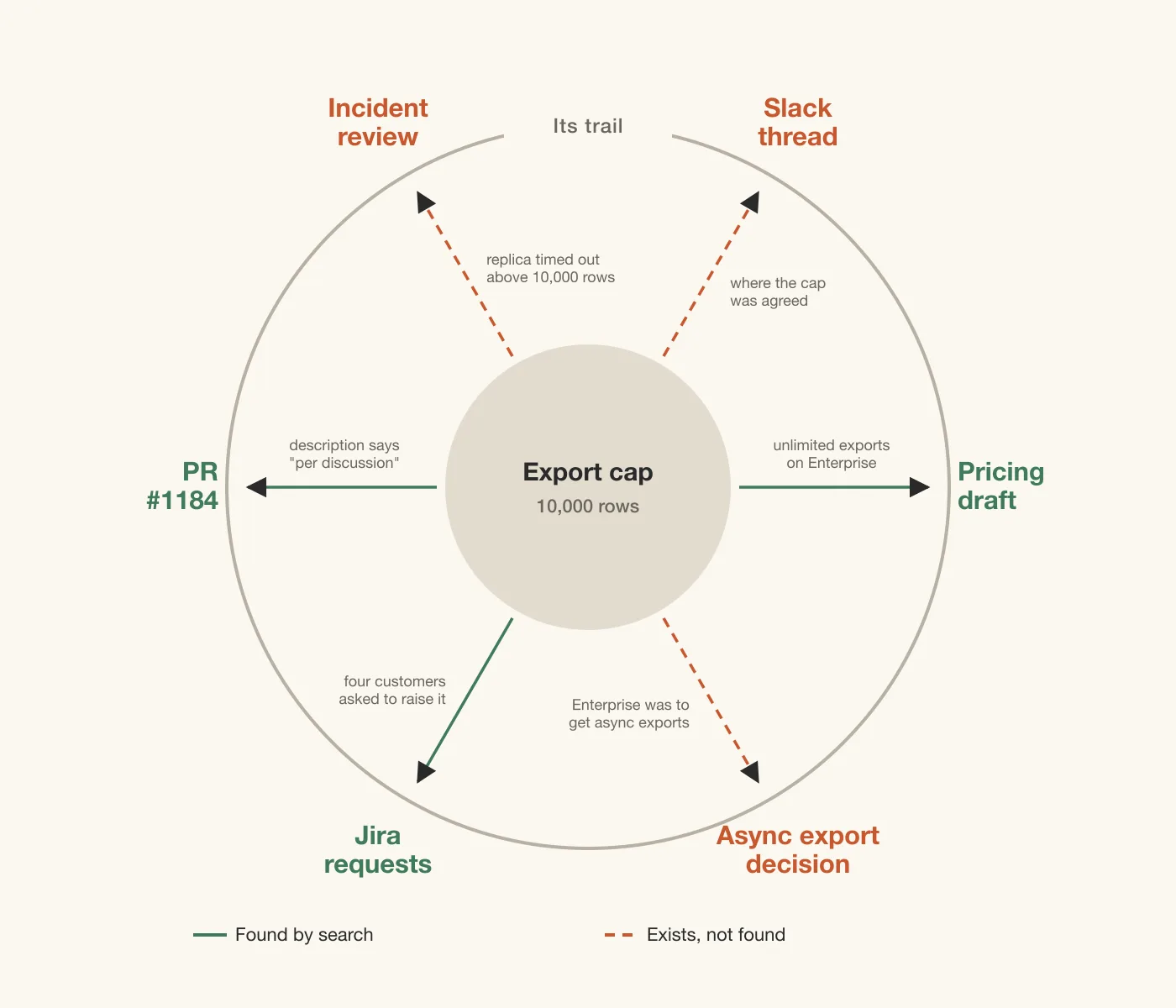
In 37 minutes the engineer made eight attempts: seven searches and a message to the PM. Seven came back with something. None of them found the reason. The reason exists. It is in three places the searches didn't reach, and nothing links them to the constant or to each other:
The man who coordinated American science during the Second World War described this problem in 1945, and sketched a machine for it.
Square-rigged ships
"As We May Think" by Vannevar Bush was published in the July 1945 issue of The Atlantic Monthly. The magazine's editor introduced Bush as Director of the Office of Scientific Research and Development, who had "coördinated the activities of some six thousand leading American scientists in the application of science to warfare." The quotations here are from the text of the Atlantic article as transcribed by Denys Duchier and mirrored by the W3C.
The essay is about the scientific record, not companies. Bush's worry was that research had outgrown the means of using it. "There is a growing mountain of research," and the investigator "is staggered by the findings and conclusions of thousands of other workers." Bush's example of the cost: "Mendel's concept of the laws of genetics was lost to the world for a generation because his publication did not reach the few who were capable of grasping and extending it."
The problem, in Bush's telling, was not that too much was written down. "The difficulty seems to be, not so much that we publish unduly in view of the extent and variety of present-day interests, but rather that publication has been extended far beyond our present ability to make real use of the record." And: "The summation of human experience is being expanded at a prodigious rate, and the means we use for threading through the consequent maze to the momentarily important item is the same as was used in the days of square-rigged ships."
Writing things down was only part of it. "A record, if it is to be useful to science, must be continuously extended, it must be stored, and above all it must be consulted."
The artificiality of indexing
Bush located the trouble in how records are found. "Our ineptitude in getting at the record is largely caused by the artificiality of systems of indexing. When data of any sort are placed in storage, they are filed alphabetically or numerically, and information is found (when it is) by tracing it down from subclass to subclass. It can be in only one place, unless duplicates are used; one has to have rules as to which path will locate it, and the rules are cumbersome. Having found one item, moreover, one has to emerge from the system and re-enter on a new path."
Then the contrast the essay is known for. "The human mind does not work that way. It operates by association. With one item in its grasp, it snaps instantly to the next that is suggested by the association of thoughts, in accordance with some intricate web of trails carried by the cells of the brain." Bush didn't idealize memory: "trails that are not frequently followed are prone to fade, items are not fully permanent, memory is transitory."
So the idea was to borrow the mind's method without its weakness. "Selection by association, rather than by indexing, may yet be mechanized." A machine could not equal the mind's speed and flexibility in following a trail, Bush wrote, but "it should be possible to beat the mind decisively in regard to the permanence and clarity of the items resurrected from storage."
Tying two items together
The machine was the memex, "a device in which an individual stores all his books, records, and communications, and which is mechanized so that it may be consulted with exceeding speed and flexibility. It is an enlarged intimate supplement to his memory." It looked like a desk, with screens, a keyboard, and microfilm inside. It could be searched "by the usual scheme of indexing," but that was the conventional part.
The new part was associative indexing, "the basic idea of which is a provision whereby any item may be caused at will to select immediately and automatically another. This is the essential feature of the memex. The process of tying two items together is the important thing." A user puts two items side by side and taps a key, and "the items are permanently joined." Items joined one after another form a trail, which can be reviewed in turn. "It is exactly as though the physical items had been gathered together to form a new book. It is more than this, for any item can be joined into numerous trails."
Bush's example is a user studying why the short Turkish bow seemed superior to the English long bow in the Crusades. The user ties an encyclopedia article to a history, adds comments, and branches into a side trail on elasticity. "Thus he builds a trail of his interest through the maze of materials available to him." Then: "And his trails do not fade." Years later, in a conversation with a friend, the trail is still there. The user photographs it and passes it on, "for insertion in his own memex, there to be linked into the more general trail."
The essay imagines professions built on trails. "The lawyer has at his touch the associated opinions and decisions of his whole experience, and of the experience of friends and authorities." There would be "a new profession of trail blazers, those who find delight in the task of establishing useful trails through the enormous mass of the common record." And the inheritance from a master would become "not only his additions to the world's record, but for his disciples the entire scaffolding by which they were erected."
A decision without its trail
The mapping that follows is ours, not Bush's. The essay is about the scientific record and a machine built from microfilm and levers, not product teams and their tools. But the search history fits the essay's complaint closely.
Every tool the engineer searched works the way Bush described indexing. Each item is filed in one place, under one system: a constant in the repo, a commit in git, a thread in a channel, a ticket in a project. Finding the PR didn't lead to the thread, because nothing tied them together. Each search meant emerging from one system and re-entering another on a new path, and each one depended on guessing the words someone used two years earlier.
The items themselves were never the problem. The incident review, the thread and the earlier decision all exist. What is missing is the trail Bush cared about: the tie between the cap, the reason for it, and what it was waiting on. A rule is in the code. Its reason, in our reading, is a trail through four tools that only the PM ever followed, and that trail faded the way Bush said a mind's trails do, when the PM left.
A coding agent asked to raise the limit has the same problem, faster. It can run the same seven searches in seconds. It finds the constant, the vague PR and the customer requests, and the most reasonable reading of those three is that the limit is arbitrary and customers want it gone. It raises the cap. Nothing it found mentions the replica, so nothing tells it the change needs the async export work first.
Our essay on the modern product development lifecycle says that "Material decisions go to a named owner, routine ones stay with the team." A limit that protects a database and shapes a pricing tier is a material decision. When it lives as a constant and a deactivated account, nobody owns it.
Where Brief fits: keeping the trail
Brief is the product strategy agent. The homepage says it "captures decisions where they happen, connects them into one graph, and acts on them." In Bush's terms, it doesn't replace the tools where items are filed. It keeps the thing those tools don't: the decision itself, with its reason, as an item that can be found and followed.
The decision becomes an item, with its reason. In the Brief app, recording a decision requires both What was decided? and Why? before Record Decision will save it, and a decision can also carry Tags and a Re-evaluate when condition. "CSV exports are capped at 10,000 rows, because larger exports timed out the reporting replica; Enterprise gets async exports instead," with a Re-evaluate when of "async exports ship," ties the constant to its reason and to the work it was waiting on.
Decisions are read from where they were made. The cap was agreed in a Slack thread, after an incident review. The homepage says Brief "reads decisions from Slack, Jira, Confluence, and GitLab, self-hosted included." A decision made in a thread doesn't have to wait for someone to copy it out by hand, or for the person who made it to still be around.
Agents find the decision before they change the code. Coding agents set up with Brief search the recorded decisions before they start work, and ask Brief to check significant changes with brief_ask in check mode, which compares a planned change against existing decisions and flags conflicts. An agent asked to raise the export limit can meet the decision about the replica before it writes the change, instead of reading the constant and the customer requests and concluding the limit is arbitrary. People can run the same check with brief ask --mode check.
A reason nobody can find gets an owner. Sometimes the search ends at a deactivated account. In the app, Propose turns an open question into a pending decision and can name Who should decide?, which records who the question belongs to. With the user's approval, an agent can record a pending decision too, and agents can call brief_list_pending_decisions to see what is waiting. When a decision is pending, an agent can hold. The homepage shows an agent asked to add per-seat pricing to the checkout API learning that D-241, the seat-based pricing decision, is pending, and replying: "Holding the pricing change until D-241 is decided."
The trail outlasts the person. Bush's user could hand a trail to a friend years later. A recorded decision keeps its Why?, and when a decision changes, its History shows its status changes. When the PM who owned exports leaves, the reason for the cap doesn't leave with them.
None of this is a memex, and it doesn't make search unnecessary. Brief can only check against decisions it has. Where a decision was never captured, there is nothing for it to flag. What Brief changes is how many decisions exist only as a constant in the code and a trail in one person's head.
Bush ended the essay hoping people could "reacquire the privilege of forgetting the manifold things" they do not need "to have immediately at hand, with some assurance" they "can find them again if they prove important." When someone asks why a limit exists, how sure are you that your team can find the reason again?
Objections
What is "As We May Think"?
"As We May Think" is an essay by Vannevar Bush, published in The Atlantic Monthly in July 1945. It argues that the scientific record had grown beyond our ability to use it, that systems of indexing make records hard to find, and that a machine could help people select records by association instead. It introduced the memex.
What is the memex?
The memex is a device Bush imagined: a desk with screens, a keyboard and microfilm storage, in which a person could store "all his books, records, and communications." Its essential feature was associative indexing, which let a user tie any two items together and build trails of linked items that could be followed again later and shared with others.
What did Bush mean by associative trails?
Bush wrote that the human mind "operates by association," moving from one item to the next along "some intricate web of trails." The memex would let people build such trails deliberately and permanently. In Bush's words, "the process of tying two items together is the important thing," and unlike the mind's, the memex's trails "do not fade."
How does "As We May Think" apply to AI coding agents?
Coding agents search a team's code and tools much as Bush described indexing: each item is filed in one place, and a search has to guess the right words. In our reading, a product decision's reason is often spread across several tools with nothing linking them, so an agent can find the code and miss the reason. It may then change something the team decided on purpose.
How does Brief help teams keep the reasons behind decisions?
Brief records product decisions with their reasons and an optional Re-evaluate when condition, and reads decisions from Slack, Jira, Confluence and GitLab. Coding agents set up with Brief search recorded decisions before they start work and use check mode to flag conflicts in significant changes, and questions nobody can answer can be proposed as pending decisions that name who should decide. Brief can only check against decisions it has, so where a decision was never captured, there is nothing for it to flag.