Here is Thursday's standup digest at an invented company, posted by a bot that collects one line from everyone who shipped something:
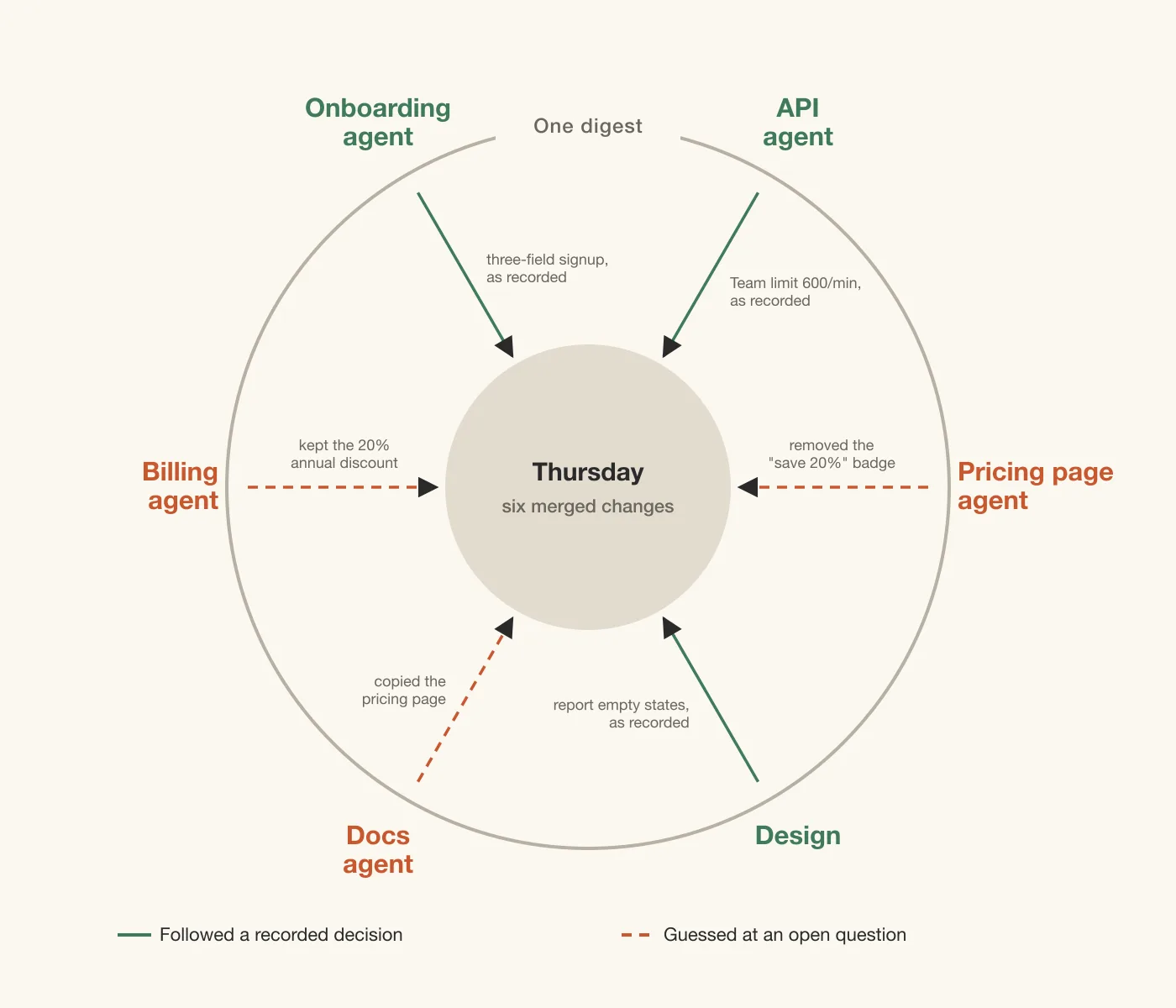
Billing agent: Added the 20% annual discount to the new checkout, per BIL-412. Merged.
Pricing page agent: Removed the "save 20%" badge from annual plans. The ticket said annual discounts are going away. Merged.
Docs agent: Updated the plan comparison page from the current pricing page. Merged.
Onboarding agent: Cut the signup form to three fields, as recorded last week. Merged.
API agent: Raised the Team plan rate limit to 600 requests a minute, as recorded. Merged.
Dana (design): New empty states for reports, as recorded at the spec review. Merged.
Priya (engineering): Reviewed 14 agent pull requests. All approved.
Marco (product): Still deciding whether the annual discount stays. Should have an answer next week.
Every line is reasonable. Three of them are answers to a question the last line says nobody has answered yet. The billing agent kept the discount. The pricing page agent removed it. The docs agent copied the pricing page, so the docs now agree with one guess and checkout agrees with the other. Priya approved all three, one pull request at a time:
A programmer studying Linux explained, almost thirty years ago, why many contributors working at once can make software better. The same essay explains why it didn't help here.
The cathedral and the bazaar
Eric S. Raymond's "The Cathedral and the Bazaar" was first officially presented at the Linux Kongress in May 1997, according to the revision history published with it, and O'Reilly printed it in book form in 1999. The quotations here are from version 3.0, published on Raymond's site at catb.org.
The essay starts with a surprise. Raymond had believed "that the most important software (operating systems and really large tools like the Emacs programming editor) needed to be built like cathedrals, carefully crafted by individual wizards or small bands of mages working in splendid isolation, with no beta to be released before its time."
Then came Linux. Linus Torvalds's style of development, "release early and often, delegate everything you can, be open to the point of promiscuity," came as a surprise. The Linux community "seemed to resemble a great babbling bazaar of differing agendas and approaches," out of which "a coherent and stable system could seemingly emerge only by a succession of miracles." It worked, and Raymond set out to understand why, by running his own project, fetchmail, "in the bazaar style."
Given enough eyeballs
Along the way, the essay proposes numbered aphorisms. The seventh is "Release early. Release often. And listen to your customers." The eighth is the famous one: "Given a large enough beta-tester and co-developer base, almost every problem will be characterized quickly and the fix obvious to someone." Or, less formally, "Given enough eyeballs, all bugs are shallow." Raymond named it Linus's Law.
Raymond thought it held "the core difference underlying the cathedral-builder and bazaar styles." To the cathedral builder, bugs are "tricky, insidious, deep phenomena." In the bazaar view, "you assume that bugs are generally shallow phenomena," or at least "that they turn shallow pretty quickly when exposed to a thousand eager co-developers pounding on every single new release."
The reason it scales is the part that matters here. "Linus's Law can be rephrased as 'Debugging is parallelizable'. Although debugging requires debuggers to communicate with some coordinating developer, it doesn't require significant coordination between debuggers. Thus it doesn't fall prey to the same quadratic complexity and management costs that make adding developers problematic."
The coordinator
The bazaar in the essay is not leaderless. Raymond wrote that "one cannot code from the ground up in bazaar style." A project needs "a plausible promise" before it goes public, and it needs a coordinator. "I think it is not critical that the coordinator be able to originate designs of exceptional brilliance, but it is absolutely critical that the coordinator be able to recognize good design ideas from others." And a bazaar project coordinator "must have good people and communications skills."
Raymond's counter to Brooks's Law carries the same condition: "Provided the development coordinator has a communications medium at least as good as the Internet, and knows how to lead without coercion, many heads are inevitably better than one."
An endnote adds a sharper point, credited to John Hasler. The costs of duplicated work, Hasler proposed, grow more slowly with team size than "the planning and management overhead that would be needed to eliminate them." Raymond suggested one plausible reason: "it is much easier to agree on functional boundaries between different developers' code that will prevent duplication of effort than it is to prevent the kinds of unplanned bad interactions across the whole system that underly most bugs."
A bazaar of agents
The mapping that follows is ours, not Raymond's. The essay is about volunteer open-source projects in the 1990s, where users chose to become co-developers. A team's coding agents are not volunteers, and they don't choose what to work on. But the shape of the digest is a bazaar: many contributors, each on its own ticket, shipping often, with review as the eyeballs.
In Raymond's account, Linus's Law scales because debuggers have to communicate with a coordinating developer but not, in any significant way, with each other. The annual discount is a different kind of problem. It isn't a defect that a thousand eyeballs can characterize. It is an open product question, and its answer has to be the same in checkout, on the pricing page and in the docs. Each agent working alone produced a defensible answer. Together they produced a contradiction, one of "the kinds of unplanned bad interactions across the whole system" that Raymond said are harder to prevent than duplicated effort.
More eyeballs wouldn't have helped either, in our reading. Priya saw each pull request on its own, and each one was fine on its own terms. What she didn't have was the one fact that made three of them wrong together: the question was still open, and Marco owned it.
That is the coordinator's job in the essay, and it doesn't parallelize. Raymond's coordinator could keep up with a bazaar because debuggers mostly didn't need coordinating with each other. Agents making product decisions do. When a team adds agents, it adds contributors to the bazaar without adding coordinators.
Our essay on the modern product development lifecycle says that "Material decisions go to a named owner, routine ones stay with the team." Whether annual plans get a discount is a material decision with a named owner. The digest shows the owner and the agents never met.
Where Brief fits: a coordinator that keeps up
Brief is the product strategy agent. The homepage says it "captures decisions where they happen, connects them into one graph, and acts on them." In Raymond's terms, it doesn't replace the coordinator, and it doesn't make the open question any easier to answer. It gives every contributor in the bazaar the same view of what has been decided, and what hasn't.
Settled questions are written down once, for everyone. In the Brief app, recording a decision requires both What was decided? and Why? before Record Decision will save it, and a decision can also carry Tags and a Re-evaluate when condition. The onboarding and API agents in the digest worked from decisions "as recorded." "The Team plan allows 600 API requests a minute, because larger customers were hitting the old limit during nightly syncs" is one answer that every agent reads the same way.
Decisions are read from where they were made. Most settled answers start in a thread or a ticket. The homepage says Brief "reads decisions from Slack, Jira, Confluence, and GitLab, self-hosted included." A decision made in one team's channel can reach an agent working on another team's ticket.
Agents check before they answer a question themselves. Coding agents set up with Brief search the recorded decisions before they start work, and ask Brief to check significant changes with brief_ask in check mode, which compares a planned change against existing decisions and flags conflicts. If the annual discount had been decided, the billing agent and the pricing page agent could each have met the same decision before writing their changes, instead of reading their tickets two different ways. People can run the same check with brief ask --mode check.
Open questions are visible, with an owner. Marco's line was the only place in the digest that said the question was open. In the app, Propose turns an open question into a pending decision and can name Who should decide?, which records who the question belongs to. With the user's approval, an agent can record a pending decision too, and agents can call brief_list_pending_decisions to see what is waiting. When a decision is pending, an agent can hold. The homepage shows an agent asked to add per-seat pricing to the checkout API learning that D-241, the seat-based pricing decision, is pending, and replying: "Holding the pricing change until D-241 is decided." That is the line the billing and pricing page agents never wrote.
When the answer arrives, it reaches everyone. When Marco decides, the decision is recorded once, with its Why?, and its History shows its status changes. The next agent to touch checkout, the pricing page or the docs works from the same answer.
None of this makes product decisions parallelizable, and it doesn't replace the person who makes them. Brief can only check against decisions it has. Where a question was never captured as decided or pending, there is nothing for it to flag. What Brief changes is how many of a bazaar's contributors are answering the same open question on their own, in different ways, on the same day.
Raymond wrote that many heads are better than one, provided the coordinator has a good enough communications medium. Your team now has more heads than ever. Does each of them know which questions are still open, and who owns them?
Objections
What is "The Cathedral and the Bazaar"?
"The Cathedral and the Bazaar" is an essay by Eric S. Raymond, first officially presented at the Linux Kongress in 1997 and published as a book by O'Reilly in 1999. It contrasts two styles of software development: the "cathedral," built carefully by a small group with infrequent releases, and the "bazaar," the open, release-early style Raymond saw in Linux, and argues that the bazaar style works.
What is Linus's Law?
Linus's Law is Raymond's name for the idea that "given enough eyeballs, all bugs are shallow." In its numbered form: "Given a large enough beta-tester and co-developer base, almost every problem will be characterized quickly and the fix obvious to someone." Raymond rephrased it as "Debugging is parallelizable."
Did Raymond say bazaar projects need no leader?
No. Raymond wrote that "one cannot code from the ground up in bazaar style," that a project needs "a plausible promise" to start, and that it is "absolutely critical that the coordinator be able to recognize good design ideas from others." The coordinator also needs good people and communications skills.
How does "The Cathedral and the Bazaar" apply to AI coding agents?
A team running many coding agents resembles a bazaar: many contributors shipping in parallel, with review catching problems. In our reading, Linus's Law fits bugs, which rarely need coordination between the people fixing them, better than open product questions, which need one answer everywhere. Agents working on separate tickets can answer the same open question in different ways, and review of each pull request alone may not catch it.
How does Brief help teams running many coding agents?
Brief records product decisions with their reasons and reads decisions from Slack, Jira, Confluence and GitLab. Coding agents set up with Brief search recorded decisions before they start work and use check mode to flag conflicts in significant changes, and open questions can be proposed as pending decisions that name who should decide, so an agent can hold instead of guessing. Brief can only check against decisions it has, so where a question was never captured, there is nothing for it to flag.