Status Reporting
Brief turns the team’s work into updates each reader can use, with every claim linked back to its source.
Same work,
three readers
Each reader needs a different cut of the same tickets, pull requests, and decisions. Ask Brief for each one in Slack.
-
The squad
Next steps and blockers.
Product Manager
@Brief Run meridian-reports for the Enterprise Analytics squad: completed, planned, risks. Keep it under 150 words with source links.
Brief answers in
- Completed
- Planned
- Risks
-
A VP
Progress and dependencies.
Product Manager
@Brief Run meridian-reports for the VP: outcomes, dependencies, and decisions needed.
Brief answers in
- Outcomes
- Dependencies
- Decisions needed
-
Leadership
What changed, and what needs attention.
Product Manager
@Brief Run meridian-reports for leadership. Keep it concise.
Brief answers in
- Shipped
- Approved
- In progress
- Risks
Edit it like a draft.
The facts stay put.
Push back in the thread. Brief rewrites against the sources and keeps completed work, approved decisions, and work in progress distinct.

Your edits hold
Under 120 words, and nothing without a direct source makes the cut.
Completed is only completed
Shipped work is listed with dates. Nothing claims it’s issue-free.
Approved decisions, linked
Each dependency is a decision in force, linked to its record.
In progress stays in progress
Committed tickets and draft PRs keep their labels. Open calls name the options.
The report names
the conflict
Brief reads open work against the decisions in force. When a ticket conflicts with one, the team gets a specific issue to resolve and an owner for it.
Documents PlanningLeadership Report (Sep 1–16, 2026)
 v3
v3
Meridian QBR Exports: Leadership Report (Sep 1–16, 2026)
 Unstarred
 Copy
Copy Download
 Comments
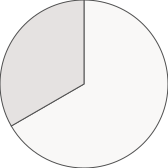
 To Do (MER-1, MER-2)
 In Progress (MER-3)
Chart scope: current Jira status snapshot for the three tracked tickets only, not a trend.
Conflicts & Risks
MER-3 vs. D-039
MER-3 proposes third-party firmographic enrichment, which directly conflicts with D-039’s CDP-only data-access mandate. Needs Engineering Lead to pause or redirect before further work.
MER-1 spec drift
MER-1’s acceptance criteria still reference the superseded default. Product Manager should correct the ticket before engineering picks it up.
Next Actions
Engineering Lead: pause/redirect MER-3 pending a CDP-compliant enrichment path.
Product Manager: update MER-1 acceptance criteria.
The conflict, by name
The ticket, the decision it breaks, and what that decision requires.
Drift caught before pickup
A ticket still citing a superseded decision is flagged before anyone builds from it.
An owner for each step
Every next action names who moves next, so the update turns straight into work.

New feedback goes
straight into the update
When a report comes in mid-cycle, ask Brief to include it. The new risk shows up linked to its source, labeled reported until someone confirms it.


Linked to where it was said
The new risk points back to the Slack message it came from.
The rest carries over
Shipped, approved, in progress, and risks carry over, each still tied to its source.
Reported, not confirmed
Brief keeps it labeled as a report until someone reproduces it.
Less time assembling status. A clearer basis for what’s next.
Brief writes each update from the tickets, pull requests, and decisions your team already works in, so every reader starts from the same facts.
Get the update without assembling it
See Brief write a squad, VP, and leadership update from your own tickets and decisions.